Kafka vs RabbitMQ in the Same System: When Each Pattern Wins
Two Brokers, One System
PFMS runs both Apache Kafka and RabbitMQ in production. This isn’t accidental or a migration artifact — each broker handles a different communication pattern:
- RabbitMQ handles account creation: transaction-service → account-service (point-to-point)
- Kafka handles budget notifications: budget-service → notification-service (fan-out capable)
Running two message brokers adds operational overhead. You maintain two Docker containers, two sets of connection configs, two monitoring dashboards. The justification: each broker’s strengths match the specific pattern it’s used for.
RabbitMQ: Point-to-Point Commands
When a user creates an account, the transaction-service posts to RabbitMQ’s account_queue. The account-service consumes from that queue.
The Producer (Transaction Service)
// transaction-service/src/app.module.ts
@Module({
  imports: [
    ClientsModule.register([
      {
        name: ACCOUNT_SERVICE,
        transport: Transport.RMQ,
        options: {
          urls: [`amqp://guest:guest@${fs.existsSync('/.dockerenv')
            ? 'host.docker.internal' : 'localhost'}:5672`],
          queue: 'account_queue',
          queueOptions: { durable: true },
        },
      },
    ]),
  ],
})
export class AppModule {}
// transaction-service/src/app.controller.ts
@Post('account')
async createAccount(@Body() account: any) {
try {
await lastValueFrom(this.accountRMQClient.emit("account-created", account));
} catch (err) {
console.error("Failed to emit to RMQ:", err);
}
}The Consumer (Account Service)
// account-service/src/app.controller.ts
@MessagePattern("account-created")
handleAccountCreated(@Payload() account: any) {
  console.log('[Account-Service]: Received account: ', account);
}
Why RabbitMQ Fits Here
- One producer, one consumer. There’s no need for multiple subscribers. Account creation is a command: “create this account.” RabbitMQ’s queue model is built for this — one message, one consumer, acknowledged and deleted.
durable: truemeans the queue and its messages survive RabbitMQ restarts. No data loss if the broker bounces.- Push-based delivery. RabbitMQ pushes messages to consumers as soon as they’re available. Low latency for command processing.
Kafka: Event Broadcasting
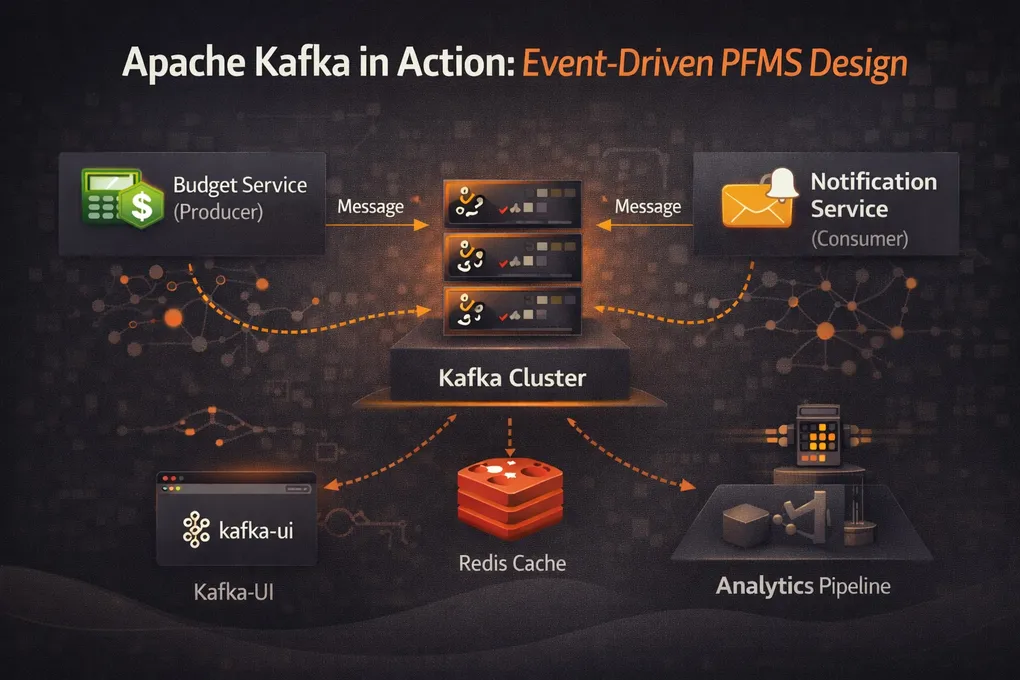
When a user creates a budget, the budget-service publishes to Kafka’s notification_requests_topic. The notification-service consumes it.
The Producer (Budget Service)
// budget-service/.../producer/BudgetNotificationProducer.java
@Service
public class BudgetNotificationProducer {
    private final KafkaTemplate<String, BudgetNotification> kafkaTemplate;
    private static final String TOPIC = "notification_requests_topic";

    @Async
    public void sendBudgetRequest(BudgetNotification request) {
        kafkaTemplate.send(TOPIC, request.getUserId(), request);
    }
}
This producer is called after the database transaction commits, via a @TransactionalEventListener(phase = AFTER_COMMIT) handler — see the Budget Service post for the full chain.
The Consumer (Notification Service)
// notification-service/.../consumer/NotificationConsumer.java
@Component
public class NotificationConsumer {
    private final NotificationService notificationService;

    @KafkaListener(topics = "notification_requests_topic", groupId = "notification-service-group")
    public void listen(NotificationRequest request) {
        notificationService.sendNotificationAsync(request);
    }
}
Why Kafka Fits Here
- Fan-out capability. Right now there’s one consumer group (
notification-service-group). But if you later add an analytics-service or audit-service, they can each create their own consumer group and independently read from the same topic — without changing the producer. - Message retention. Kafka retains messages on disk (configurable retention period). If the notification-service was down for an hour, it picks up where it left off when it comes back. With RabbitMQ, once a message is acknowledged, it’s gone.
request.getUserId()as the partition key. All events for the same user land on the same partition, guaranteeing per-user ordering. Important for notifications — you don’t want “budget updated” arriving before “budget created.”
The Technical Differences
| Aspect | RabbitMQ | Kafka |
|---|---|---|
| Delivery model | Push (broker → consumer) | Pull (consumer → broker) |
| Message lifecycle | Deleted after acknowledgment | Retained for configurable period |
| Routing | Exchanges, bindings, routing keys | Topics and partitions |
| Consumer groups | Competing consumers on one queue | Independent consumer groups per topic |
| Ordering | Per-queue FIFO | Per-partition FIFO |
| Throughput | Lower (per-message acknowledgment) | Higher (batch reads, sequential disk I/O) |
| Replay | Not possible (messages deleted) | Possible (reset consumer offset) |
Decision Framework
Based on the PFMS experience:
Use RabbitMQ when:
- One producer, one consumer (command pattern)
- You need immediate push-based delivery
- Message replay isn’t needed
- The NestJS ecosystem has first-class support (
@nestjs/microservicesTransport.RMQ)
Use Kafka when:
- Multiple consumers might subscribe now or in the future (event pattern)
- You need message retention for replay or auditing
- Ordering within a partition matters
- The Spring ecosystem has first-class support (
spring-kafka)
Could you use just one? Yes. Kafka can do point-to-point (single consumer group). RabbitMQ can do fan-out (topic exchanges). But each broker’s default model aligns better with one pattern. Using both means less configuration fighting against the grain.
The Infrastructure
Both brokers run as Docker containers on the shared pfms-network:
RabbitMQ:
# message-broker/docker-compose.yml
services:
  rabbitmq:
    image: rabbitmq:4-management
    ports:
      - "5672:5672"    # AMQP protocol
      - "15672:15672"  # Management UI
    volumes:
      - rabbitmq_data:/var/lib/rabbitmq
Kafka (KRaft mode, no ZooKeeper):
# kafka/docker-compose.yml
services:
  kafka:
    image: confluentinc/cp-kafka:7.5.0
    environment:
      KAFKA_PROCESS_ROLES: 'broker,controller'
      KAFKA_ADVERTISED_LISTENERS: 'INTERNAL://global-service-kafka:29092,EXTERNAL://localhost:9092'
      CLUSTER_ID: 'MkU3OEVBNTcwNTJENDM2Qk'
Kafka runs in KRaft mode (KAFKA_PROCESS_ROLES: 'broker,controller'), eliminating the ZooKeeper dependency. One less service to manage.
Summary
- RabbitMQ for commands (account creation): push-based, point-to-point, delete-after-ack
- Kafka for events (budget notifications): pull-based, fan-out capable, retained on disk
- Two brokers = operational overhead but each pattern gets the right tool
- NestJS ↔ RabbitMQ, Spring Boot ↔ Kafka — each framework has native support for its broker
- Could consolidate to one but you’d fight the default model for half your use cases